
Choosing the best pedal exercisers for legs starts with deciding which movement and operating style you want. A mini exercise bike uses circular pedaling, while an under-desk elliptical follows a different pedal path. Some devices rely on your own effort; others may offer powered movement.
This guide covers 4 compact seated options and explains how to compare their controls, dimensions, stability, and intended uses. These designs are not interchangeable, so confirm the exact model’s movement pattern and operating modes before buying.
We have not physically tested these products. Verify specifications and permitted uses in the manufacturer’s listing or manual, particularly if you are considering a device for a medical or rehabilitation purpose.
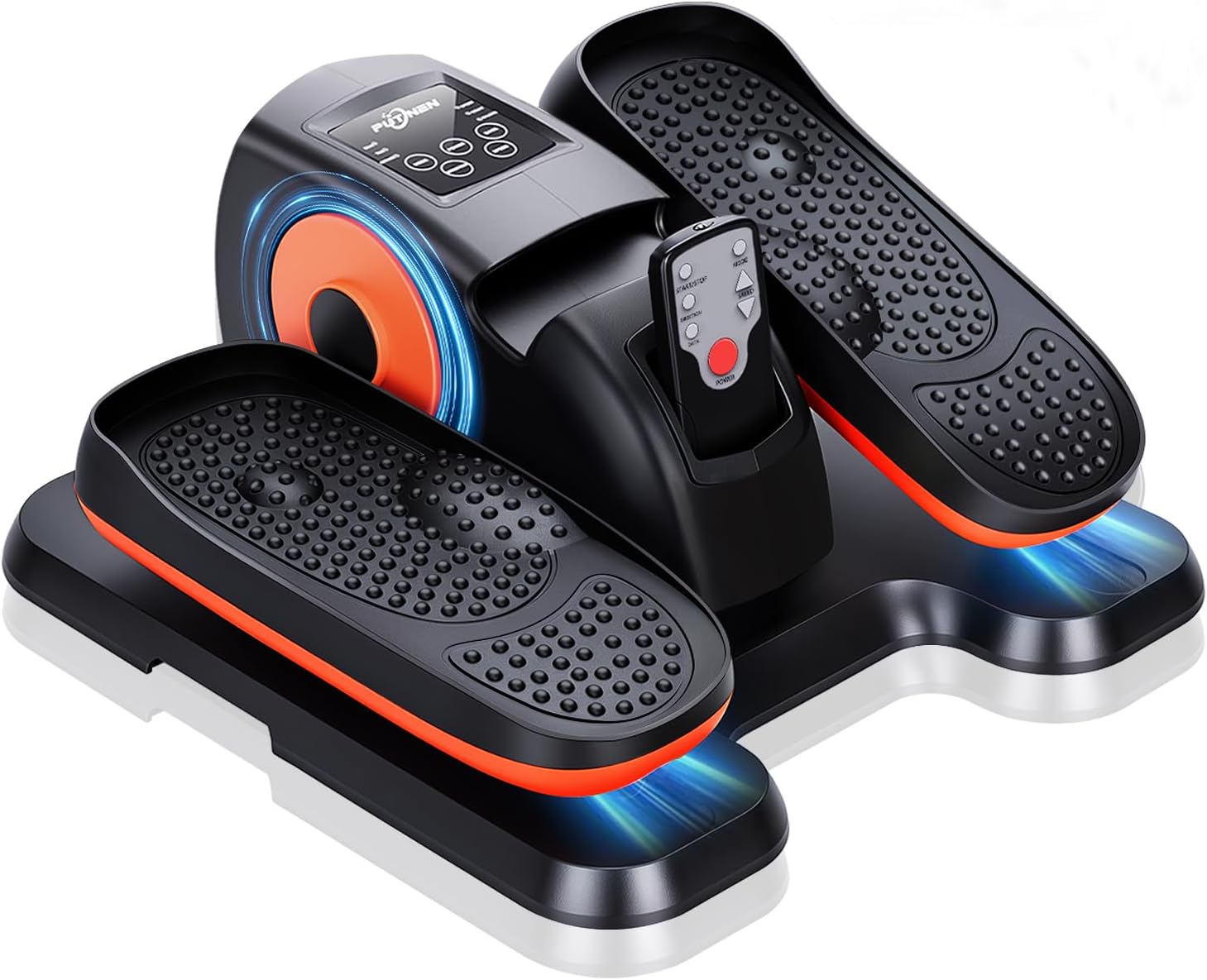
Pros
- Quiet operation
- No assembly required
- Smooth and sturdy
- Compact and portable
- Easy to adjust with remote
Cons
- Automatic mode may feel passive
- Corded power limits placement
- May slide on floor without bracing

Pros
- Ultra-quiet operation below 15dB
- Motorized with auto and manual modes
- Compact and lightweight at 11.1 lbs
- Dual control: touch screen and remote
- Low-impact, joint-friendly exercise
Cons
- Corded electric limits placement near outlet
- Maximum weight capacity 250 lbs may be low
- Stride length 15 inches may feel short
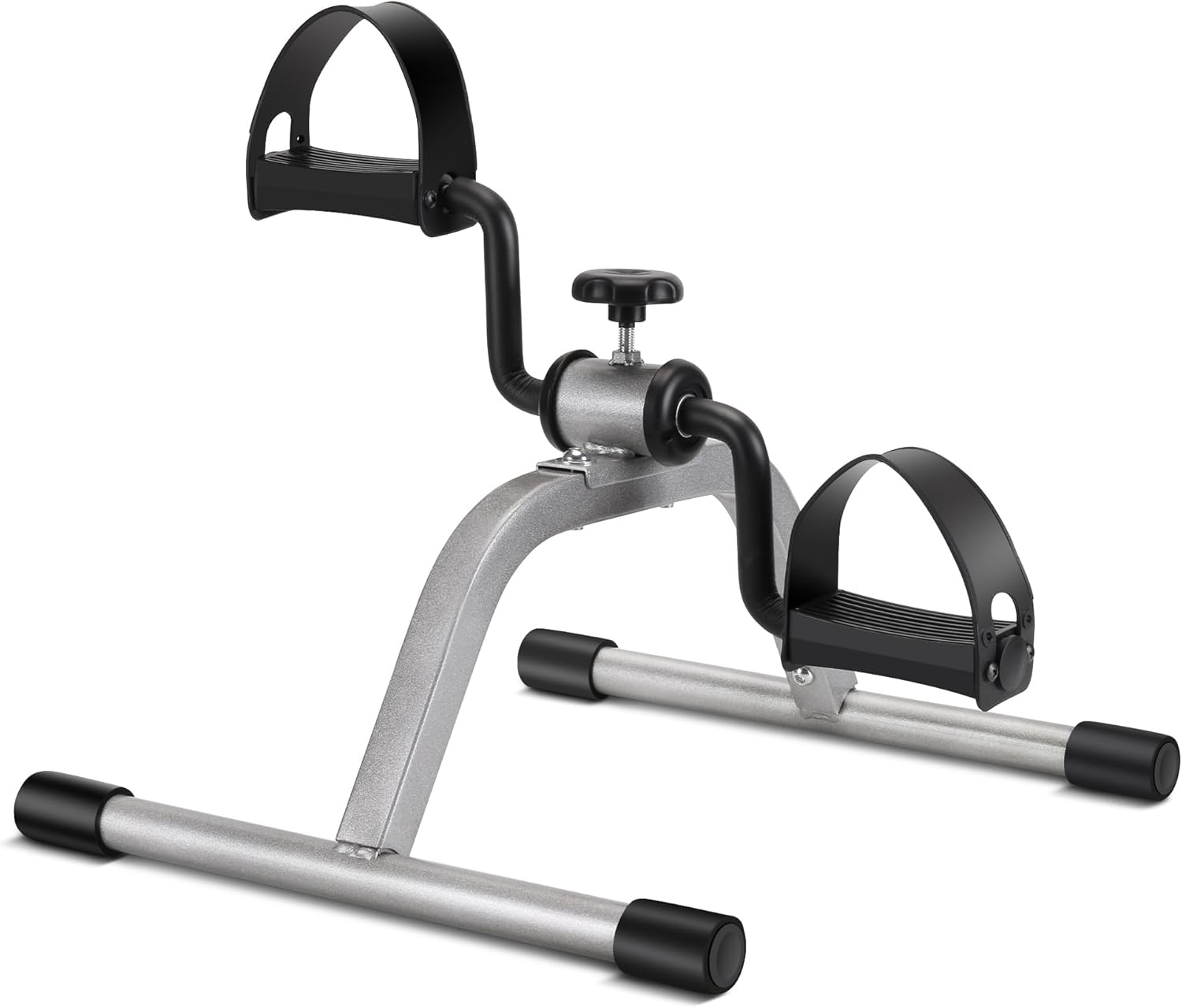
Pros
- Compact and easy to store
- Simple tool-free assembly
- Adjustable resistance levels
- Good for post-surgery recovery
- Quiet operation
Cons
- Occasional wobbly feel in pedal
- Resistance can catch on rotation
- Not for intense workouts

Pros
- Smooth magnetic resistance
- Quiet operation
- Lightweight and portable
- Easy to assemble
- Versatile for arms and legs
Cons
- Can be squeaky under heavy use
- Not stable for intense leg workouts
- Battery-powered display may need replacement
How to Choose the Best Pedal Exercisers for Legs
Mini Exercise Bike or Under-Desk Elliptical?
Start by comparing the movement pattern. A mini exercise bike has pedals that rotate around a crank. An under-desk elliptical uses foot platforms that follow an elliptical path.
The pedal height, foot position, and space needed for knee movement can differ between these designs. Check the exact product’s dimensions and instructions rather than assuming that every seated exerciser will feel or fit the same way.
Manual or Powered Operation
A manually operated device depends on your effort to move the pedals. A powered device may move its foot platforms using a motor, depending on the selected mode.
Powered speed settings are not necessarily equivalent to resistance levels. Confirm what each mode does, whether unpowered operation is permitted, and whether the device requires access to an electrical outlet.
Resistance and Adjustment
Check whether the product offers adjustable resistance, adjustable motor speed, or both. A tension knob describes a control, not necessarily the type of resistance mechanism inside the machine.
Look for clear instructions explaining what each adjustment changes. Do not compare products solely by the number of advertised settings, since those settings may control different functions.
Desk Clearance and Seated Position
Measure the available floor space and clearance beneath your desk. Consider chair height, pedal height, and the room your knees need throughout the movement.
Allow space to sit naturally without striking the desk or reaching awkwardly for the device. Follow the manufacturer’s positioning guidance and confirm that controls remain accessible.
Stability and Chair Movement
Check the base design and recommended floor surface. Both the exerciser and your chair should remain appropriately positioned during use.
A wheeled chair may move as you pedal. Review the manufacturer’s setup instructions and check whether any stabilizing accessories are included or required.
Display and Controls
Confirm which readings the display provides and how easily you can see it from your seated position. Available information may include elapsed time, revolutions, speed, distance, or estimated calories.
may help with calorie readings as estimates rather than precise measurements of energy expenditure.
If a remote control is included, check which functions it operates. Do not assume that every model offers powered modes or remote adjustment.
Noise Level
Sound may come from moving components, the drive mechanism, a motor, or vibration against the floor. Noise can also change with operating speed and placement.
We have not independently measured these products’ noise levels. Check manufacturer information and recent owner feedback about the exact model before choosing one for calls or a shared workspace.
Portability and Storage
Compare the product’s weight and dimensions with your available storage space. Confirm whether a carrying handle or folding mechanism is included.
For folding designs, check both operating and folded dimensions. Compact size alone does not establish that a device is lightweight or easy to carry.
Arm and Leg Use
Some mini exercise bikes may permit both floor use for legs and tabletop use for arms. This must be confirmed in the exact model’s instructions.
Do not assume that an under-desk elliptical can also be used for arm exercise. Use each product only in its permitted positions.
Assembly, Maintenance, and Warranty
Review the assembly instructions to see whether pedals, stabilizers, straps, or other components need installation.
Follow the product’s cleaning and maintenance guidance. Check the warranty and return policy for the exact model, seller, and purchase location.
For additional comparisons, browse our Pedal Exercisers category.
How to Use This Guide
This is a product comparison guide, not a hands-on test report or rehabilitation recommendation. It highlights features to verify before purchasing.
Confirm the movement pattern, operating modes, resistance system, dimensions, controls, and permitted uses for the exact model. Product variations and listing details can differ.
We may earn a commission from qualifying purchases made through links on this page.
Final Thoughts
Choose the device type first, then compare its specifications. Circular-pedaling mini exercise bikes and under-desk ellipticals have different movement patterns, while manual and powered operation serve different preferences.
Check desk clearance, seated positioning, stability, and accessible controls before buying. Select the model whose verified features match your intended use rather than relying on a “best overall” label or an unverified price claim.
If you are considering a device for injury recovery or a diagnosed condition, ask your may help with professional about appropriate equipment and permitted movement before use.
Frequently Asked Questions
What is the difference between a pedal exerciser and an under-desk elliptical?
A mini-bike pedal exerciser uses circular pedaling around a crank. An under-desk elliptical uses foot platforms that follow an elliptical path.
Check the movement pattern and operating instructions to decide which design suits your setup.
Can I use one while working at a desk?
Fit depends on your desk, chair, and the exact product dimensions. Measure knee clearance and floor space, and confirm that you can sit comfortably while using the device.
For a shared office, also consider noise and workplace rules.
Are speed settings the same as resistance levels?
No. Speed settings may control how quickly a powered device moves, while resistance settings change the effort needed to move a manually operated mechanism.
Check what the controls do on the exact model.
Do I need a powered exerciser?
That depends on your intended use and preferences. Confirm the operating modes, power requirements, and whether the device permits unpowered movement.
For medical or rehabilitation use, seek personalized guidance rather than selecting a powered device solely because it moves automatically.
Can the display tell me exactly how many calories I burn?
Display calorie readings are estimates. Their calculation methods and available inputs vary by model, so they should not be may help with as precise measurements.
Can I use these products for arm exercise?
Only if the manufacturer explicitly permits tabletop arm use. Do not assume that every seated leg exerciser is suitable for arms.
How much space does a seated exerciser need?
Check the exact product dimensions and allow extra room for pedal movement, your feet, your chair, and access to the controls.
The machine’s footprint alone does not establish whether it will fit comfortably beneath a desk.
Is assembly required?
Assembly requirements vary. Review the product description and manual to check which parts must be installed and which tools are needed.
How do I clean and maintain the device?
Follow the manufacturer’s instructions. Disconnect powered products before cleaning, avoid introducing liquid into electrical components, and perform any specified checks for sesupport fittings.
How should I compare budget options?
Compare the movement pattern, adjustment controls, fit, stability requirements, and warranty terms. Check current retailer prices for the exact model rather than relying on a fixed price in an article.
Can a seated exerciser be used during injury recovery?
Suitability depends on the injury, recovery stage, and device. Do not assume that a low setting or powered movement makes a product appropriate for rehabilitation.
Ask your may help with professional about equipment choice and permitted use.
This guide is for shopping research only and is not medical, health, or safety advice. Product details, availability, and prices can change; confirm current information with the manufacturer or retailer. If you are buying a mobility, wellness, or health-related product for a medical condition, recent surgery, fall risk, pain, neuropathy, circulation issues, or a care plan, consult a qualified healthcare professional before use.








Write Your Review
No reviews yet. Be the first to share your experience!