
Disclosure: As an Amazon Associate we earn from qualifying purchases. This article contains affiliate links, and we may earn a commission at no extra cost to you. We do not show prices because they change often; click through to see the current price on Amazon.
Checking your blood pressure at home sounds simple until you try it with a traditional cuff. You have to thread the cuff over your arm, pull the end tight with your other hand, line up the tube, press start and then hold still. If your hands are stiff, your shoulder is sore, or you are helping a parent who cannot manage the cuff alone, that routine can feel like a project. Many people end up skipping it.
The problem: a regular cuff is a two-handed job
A standard upper-arm cuff is a fabric wrap. To use it you need enough grip and dexterity to close the cuff snugly with one hand while the arm being measured stays relaxed. In practice that is where people struggle:
- Sore or arthritic hands make pulling and fastening the cuff slow and painful.
- Shoulder or neck discomfort makes it hard to lift the free hand to position the cuff.
- Caregivers may be measuring someone else and need a setup that works the same way every time.
- Cuff placement mistakes (too loose, twisted, wrong height) are a common reason home readings look inconsistent.
If measuring is a hassle, you measure less often, and a home log is only useful when it is regular.
The solution: no-wrap barrel-style monitors
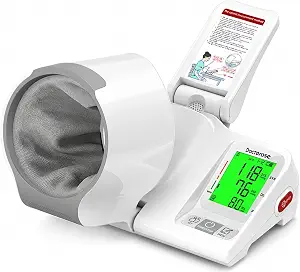
A newer style of home monitor replaces the wrap with a rigid, open-ended barrel (some listings call it an arm tunnel or slide-in cuff). You slide your arm into the barrel, rest it comfortably, and press one button; the device handles the inflation and measurement. Because there is nothing to wrap or pull tight, the setup is easier to repeat the same way each time, which is exactly what you want when tracking readings over weeks.
These models are what you often see in short videos of people sliding an arm into a white cylinder at a desk or table. We looked through the current Amazon listings for this style and shortlisted eight options. We have not tested them ourselves; the details below come from the listings and our research, so always check the current listing before you buy.
At a Glance
| Brand | Design and arm fit | Memory | Power | Rating |
|---|---|---|---|---|
| CAVN | Arm tunnel, 8.7-15.7 in | 4 users x 199 | USB-C or battery | 4.6 / 5 |
| Saker | Slide-in no-wrap, 8.7-15.7 in | 4 users x 199 | See listing | 4.1 / 5 |
| Arboleaf | Arm-in no-wrap, 8.7-15.7 in | 4 users x 199 | AA or USB-C | 4.5 / 5 |
| CAVN | Barrel-type, 7.1-16.5 in | 2 users x 99 | Rechargeable | 4.8 / 5 |
| CAVN | Barrel-type, 7.1-16.5 in | 2 users x 99 | USB-C rechargeable | 4.1 / 5 |
| YGKW | Barrel-type, 7.1-16.5 in | 2 users x 99 | USB-C rechargeable | 5.0 / 5 |
| Doctorose | No-wrap auto-fit, 7.1-16.5 in | 2 users, 198 memory | See listing | 4.4 / 5 |
| Beown | No-wrap, 7.1-16.5 in | 2 users x 99 | Rechargeable | 4.9 / 5 |
Details are taken from the Amazon listing titles and can change; ratings come from the listings when we last checked. Several of these listings are new and have a small number of reviews, so treat the ratings as early signals.

Pros
- No-wrap design eliminates cuff discomfort
- Simple one-button operation
- Highly rated user satisfaction
- Lightweight and easy to store
- Clear, large display
Cons
- Expensive for the segment
- Limited to home use only
- Newer brand with fewer reviews

Pros
- No-wrap cuff for easy application
- FDA-cleared for accuracy assurance
- Large, clear display
- Batteries included
- Comfortable arm fit
Cons
- Higher price point
- Limited color options
- Battery life may vary

Pros
- Simple one-button operation
- No-wrap cuff for easy use
- Large, high-contrast display
- USB-C power option
- Suitable for most adult arms
Cons
- No Bluetooth or app sync
- Not for users with certain conditions
- Requires batteries or USB-C

Pros
- Easy one-touch operation
- No-wrap cuff for seniors
- Large display with backlight
- Two-user memory
- FDA-cleared accuracy
Cons
- Requires proper arm positioning
- May feel tight during inflation
- Not portable for travel

Pros
- No-wrap cuff for easy use
- Elbow positioning for accuracy
- Senior-friendly interface
- Compact and lightweight design
- Simple time/date adjustment
Cons
- Time resets if stop button pressed
- Expensive for the segment
- Limited user reviews available

Pros
- No-wrap design is easy to use
- Comfortable for repeated measurements
- Large display is easy to read
- Rechargeable battery included
- Portable and lightweight
Cons
- Higher price point than typical monitors
- Limited reviews, new product
- May not fit very large arms
Pros
- Simple one-touch operation
- Automatic inflation for consistent readings
- Large display with clear numbers
- Includes batteries, ready to use
- Portable and lightweight design
Cons
- Only 8 ratings, limited feedback
- Battery type nonstandard, may be hard to replace
- Heavier than some competitors

Pros
- ±3 mmHg clinical accuracy
- Easy one-button operation
- Adaptive cuff with arm guide
- Rechargeable USB-C battery
- FSA eligible
Cons
- Cannot use while charging
- No cuff size options mentioned
- Limited user reviews so far
How to pick the right no-wrap monitor
Check the arm range first
Barrel monitors do not adjust like a fabric cuff, so the stated arm circumference range matters. Several of the models above list 7.1-16.5 inches; others list 8.7-15.7 inches. Measure around the upper arm, about halfway between shoulder and elbow, and make sure you sit comfortably inside the range rather than at the very edge.
Think about who will use it
If two people share the device, the user memory matters. Some of these list 2 users with 99 readings each; others list 4 users with 199 each, which suits a couple plus a parent who visits.
Power and display
USB-C rechargeable models are convenient if you do not want to hunt for batteries, while units that also run on AA batteries are handy for travel or a power cut. A large, backlit display helps older eyes, and colour-coded backlights can make results easier to read at a glance.
Look for validation, and verify it
Several listings say “FDA-cleared”. That is the seller’s claim, so confirm it on the listing and in the product manual before you rely on it. If accuracy is a priority, ask your clinician to compare one reading from your home monitor with their own device at your next visit.
Check the return window
Because fit is fixed, buy from a seller with an easy return policy in case the barrel does not suit your arm.
Tips for steadier home readings
These are general tips commonly shared by clinicians; always follow your device manual and your doctor’s advice.
- Rest quietly in a chair for a few minutes before measuring.
- Sit with your back supported and feet flat on the floor.
- Rest the arm on a table so it is at about heart level.
- Do not talk or scroll your phone during the reading.
- Measure at similar times each day and write results down or use the memory.
Frequently asked questions
Are barrel-style monitors as accurate as cuff monitors?
We cannot verify accuracy for any specific model. Look for a clearly stated validation or clearance in the listing and manual, and ask your doctor to compare readings with their equipment.
Can a no-wrap monitor replace a visit to the doctor?
No. A home monitor only records numbers. It does not diagnose anything. Talk to a healthcare professional about what your readings mean and what to do about them.
What if my arm is larger or smaller than the listed range?
Choose a model whose range clearly includes your arm, or consider a traditional monitor sold with several cuff sizes. A poorly fitting device can give misleading readings.
Is this good for seniors or caregivers?
The one-button, no-wrap design can make repeat measurements easier for people with limited hand strength. Make sure the person can position the arm comfortably and that someone supervises if they are unsure.
More products: browse the full list in our Home Health Monitors shop, or see more ideas in our Shop.
This article is for shopping research only and is not medical advice. Blood pressure readings should be interpreted by a healthcare professional. If you have chest pain, severe headache, trouble breathing or other urgent symptoms, seek emergency care instead of measuring at home.









Write Your Review
No reviews yet. Be the first to share your experience!